
-
 Regular price From 5,76 €Regular price
 -
 Regular price From 4,52 €Regular price
Writable Ziplock Bags for Your Application
Writable ziplock bags are particularly handy in specific industries and application contexts. Here is an overview of suitable ranges:
- Ziplock bags for spare parts – workshop sorting with screw and split-pin descriptions on the write-on panel
- Ziplock bags for small parts – screws, nuts and washers in industry
- Ziplock bags with Euro hole – with a hanging opening for the retail shelf and POS display
Background knowledge on the closure mechanism, material comparisons and application cases can be found in our detailed guides: zip bags compared (press-seal vs. slider vs. double zip), resealable bags overview (all five main variants explained), PE bag guide (LDPE vs. HDPE material comparison).
Related Ziplock Bag Variants
Looking for a different ziplock variant? Here are the most important alternatives from our range:
- Ziplock bag range – the complete overview of all ziplock bag variants
- Extra strong ziplock bags – from 150 microns film thickness for sharp-edged contents such as sheet metal, glass shards or coarse workshop parts
- Small ziplock bags – mini formats from 40×60 mm for tablets, jewellery and sample packaging
- Large ziplock bags – XL formats from 200×300 mm for large workshop parts and tool sets
- Food-grade ziplock bags – EU 10/2011 certified for direct food contact
- Transparent ziplock bags – crystal-clear for maximum visibility of the contents
Popular individual products from this range:
Delivery, Samples and Custom Production
Shipping is fast and reliable from our German warehouse – the standard range is available immediately. For larger order quantities or recurring needs, do get in touch with us for individual terms and tiered pricing.
Not sure whether the film thickness or size suits your application? We are happy to send free samples before your first order – you can test the ziplock bags with write-on panel in your specific environment before ordering larger quantities.
For individual requirements we offer custom production: bespoke dimensions (outside the standard sizes), an alternative number of write-on strips, individual printing with your logo or special film thicknesses. For food applications with a declaration of conformity to EU 10/2011 → request a custom production.
What are ziplock bags with a write-on panel?
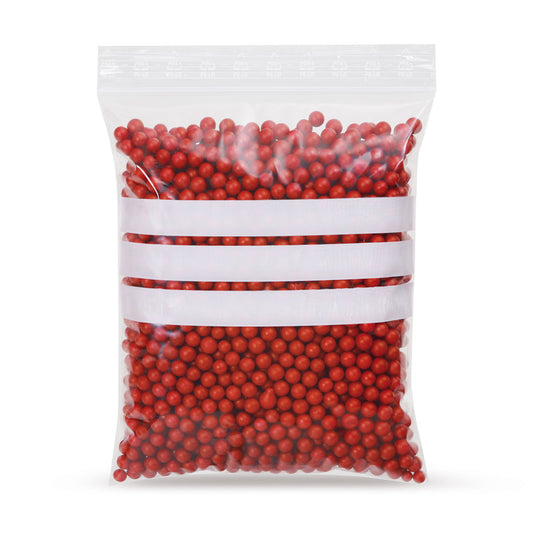
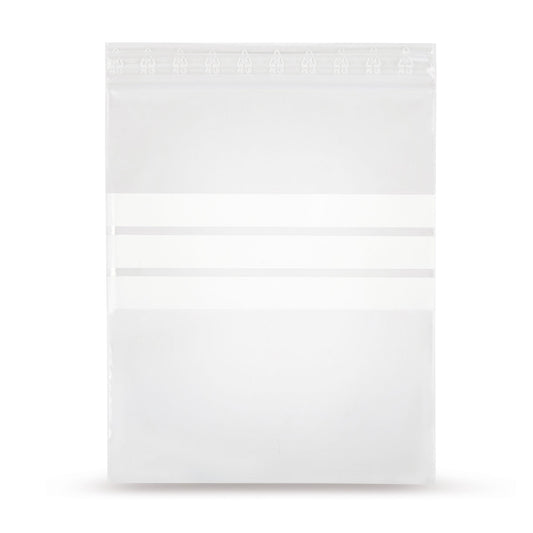
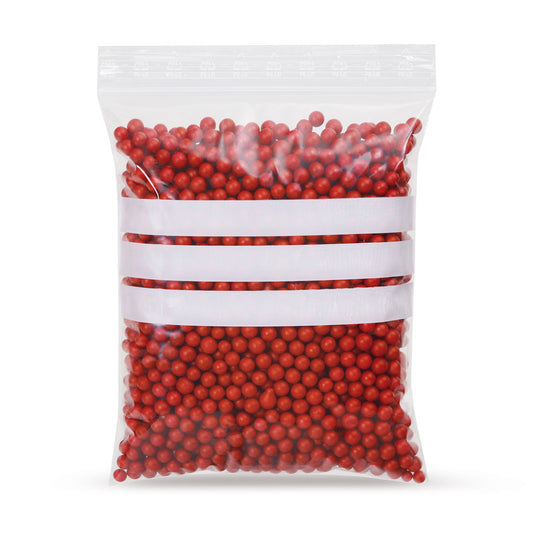
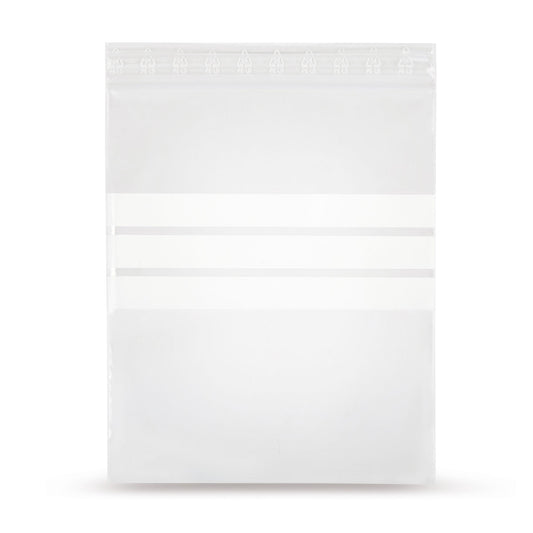
Ziplock bags with a write-on panel are resealable zip bags with printed white strips for labelling directly. The strips are available as a 1-strip or 3-strip variant and can be written on with all common pens – permanent marker, ballpoint pen, felt-tip pen or pencil. This does away with separate adhesive labels and keeps the labelling firmly attached to the bag.
The zip closure consists of two small profiles that interlock tightly when pressed together. You can open and close the bag as often as you like – typically 500+ cycles without any noticeable loss of seal integrity. Handy for storing food with type and best-before details, workshop sorting with screw descriptions, or pharmacy samples with patient identification.
The material is LDPE (low-density polyethylene) – flexible, tear-resistant, recyclable in the PE stream. Film thicknesses are typically between 60 and 100 microns; for workshop use we recommend at least 90 microns. Food-grade certification to EU 10/2011 is available on request.
Compared with classic bags without a write-on panel, these variants have the decisive advantage of permanent content labelling. Instead of sticking on labels afterwards (which come loose or get dirty), you write the contents, date or patient data directly onto the bag – clearly legible and tamper-proof.
What are ziplock bags with a write-on panel used for?
Ziplock bags with a write-on panel are used wherever the contents of a bag need to be clearly identified – without having to rely on separate labels. In the workshop, practice, kitchen and hobby spheres they are one of the most practical sorting solutions there is.
- Workshop sorting of spare parts – label screws, split pins and small mechanical parts with size and type so the right screw is always found quickly.
- Pharmacy and practice documentation – patient samples, tablet portions and dosing packs with patient name and date, hygienic and tamper-proof.
- Kitchen spice storage – spices and baking ingredients with type and best-before details, ideal for a clearly organised pantry.
- Jewellery and collector sorting – gemstones, coins and stamps with type or value labelling in the hobby collection.
- Sample packaging in marketing – product samples with type or batch number for trade fairs and direct marketing campaigns.
- Craft and hobby use – beads, buttons and small materials sorted by colour or size, always labelled and easy to find again.
Thanks to their resealable design, the bags are practical for all applications where contents have to be removed and resealed tightly more than once – without losing the content labelling.
Which ziplock bags with a write-on panel suit your needs?
You choose the right variant according to the number of strips, bag size, film thickness and food-grade requirement. Here is an overview of the most important selection criteria:
- Number of write-on strips – 1 strip for simple labelling (type or date), 3 strips for detailed information (type, best-before date, batch).
- Bag size by contents – 40×60 mm for tablets/jewellery, 80×120 mm for screws/small materials, 200×300 mm for spice supplies or larger workshop sorting.
- Film thickness by load – 60–80 microns for light contents (powders, tablets), 90–120 microns for workshop screws, from 150 microns for sharp-edged contents (see extra strong).
- Food-grade certification – for direct contact with food (spices, kitchen supplies) request the EU 10/2011 certified variant.
- Material variant – standard clear LDPE or food-grade for food applications. For sustainable brands, recycled LDPE with a GRS certificate is also available.
- Special sizes and printing – individual dimensions, an alternative number of strips or printing with your company logo as a custom production.
Not sure? We send free samples in advance – this way you can test the right film thickness and size on your specific application before ordering larger quantities.
The everyday benefits of ziplock bags with a write-on panel
The decisive advantage of this bag variant is the integrated labelling without separate stickers. Stickers come loose over time, get dirty, leave adhesive residue or can easily be removed by children. The printed write-on strips, by contrast, are firmly attached to the bag and stay legible permanently.
In practice this means: cleaner organisation in the workshop and kitchen, less risk of mix-ups with patient samples in the practice and tamper-proof sample-shipping packaging in marketing. Anyone who has once used the benefits of write-on panel bags is reluctant to go back to working with adhesive labels.
Economically, the bags are convincing thanks to their reusability (500+ opening cycles) and the savings on label costs. With careful handling they last for many years without the write-on strips or the zip closure losing their function. For food applications, conformity to EU 10/2011 is maintained – provided the bags are kept clean.
Material & Technical Specifications
Ziplock bags with a write-on panel are made from LDPE (low-density polyethylene) – the classic material for resealable bags. Film thicknesses are typically between 60 and 100 microns. For workshop applications with sharp-edged screws or split pins, we recommend at least 90 microns to ensure puncture resistance.
The write-on strips are made from white, printable material applied directly to the film. They take all common pens: permanent markers (Edding and similar), ballpoint pens, felt-tip pens and even pencil for erasable labelling. Depending on the variant, 1 or 3 strips are available.
For direct food contact (e.g. storing spices in the kitchen, shipping samples in the pharmacy), food-grade certification to EU 10/2011 is available on request – with the corresponding declaration of conformity. Recyclable in the PE stream (yellow bag / yellow bin).
Frequently Asked Questions about Ziplock Bags with Write-On Panel
How many write-on strips are printed on the ziplock bags?
As standard, our bags have one or three white write-on strips, depending on the product variant. The strips are printed directly onto the LDPE film and can be written on with all common pens (permanent marker, ballpoint pen, felt-tip pen). On request, variants without strips or with a bespoke layout are also available as a custom production.
Which pen is best for writing on the bags?
A permanent marker (e.g. Edding) gives the most durable label – smudge-proof and waterproof. Ballpoint and felt-tip pens also work without any trouble for short-term labelling. A pencil can be used too and can later be erased – handy for frequent reuse with changing contents.
Does the writing stay permanently visible?
With a permanent marker or felt-tip pen the writing stays permanent and smudge-proof, even under mechanical abrasion. With ballpoint pen, the writing may fade over time, especially under UV exposure. For very long-lasting labelling we recommend waterproof industrial markers.
Are the ziplock bags with write-on panel certified food-grade?
Food-grade certification to EU 10/2011 is available on request – including the corresponding declaration of conformity. This matters above all where the bags are in direct contact with food (e.g. storing spices in the kitchen, sample packaging in the pharmacy).
Which film thickness do I need for workshop use with screws?
For workshop applications with sharp-edged contents such as screws, split pins or small mechanical parts, we recommend a film thickness of at least 90 microns. For especially sharp contents (e.g. thread tips, sheet metal) it is better to choose the extra strong variant from 150 microns – see extra strong ziplock bags.
What sizes are available for ziplock bags with write-on panel?
The standard range runs from 40×60 mm for mini applications up to 200×300 mm for larger contents. For small formats for tablets and jewellery see mini ziplock bags, for XL formats for large workshop parts large ziplock bags. Special sizes outside the standard grid are made as a custom production.
How often can I open and reseal a ziplock bag?
High-quality press-seal closures typically withstand 500 opening cycles without any noticeable loss of seal integrity. With careful handling (no powder or adhesive residue in the profile) many more reuses are also possible. For very frequent reuse, switching to the slider bags is worthwhile.
Are the bags suitable for patient documentation in the practice?
Yes – the write-on panel variant is standard for practice use. Patient name, sample date and type of examination can be written directly onto the strips with a permanent marker. For clinical hygiene applications with additional requirements, get in touch with us for advice.
Are the bags suitable for storing spices in the kitchen?
Yes – with the food-grade variant. The write-on panels make it easy to note the spice name, type and best-before date directly. More practical than separate labels and visually consistent. With fine spice powders, clean the zip carefully before filling for the first time.
Can I have the bags printed with my company logo?
Yes – printing with a logo, brand identity or mandatory information is possible as a custom production. Printing methods: flexographic printing (cost-effective for larger runs), gravure printing (premium quality) or digital printing (standard quantities). Minimum quantity and lead time on request → request a custom production.
What minimum order quantity do I need for an order?
For standard ziplock bags with write-on panel there is no minimum order – you can also order individual packs (e.g. 100 or 500 units). For bespoke printing or special sizes, higher minimum quantities apply, which we calculate individually.
How do I store the ziplock bags correctly?
Store dry, dark and at room temperature. Avoid direct sunlight – UV radiation can make LDPE brittle over months. In their original packaging the bags remain stable in storage for several years without any loss of function at the zip closure.