
-
 Regular price From 14,03 €Regular price
 -
 Regular price From 5,70 €Regular price
 -
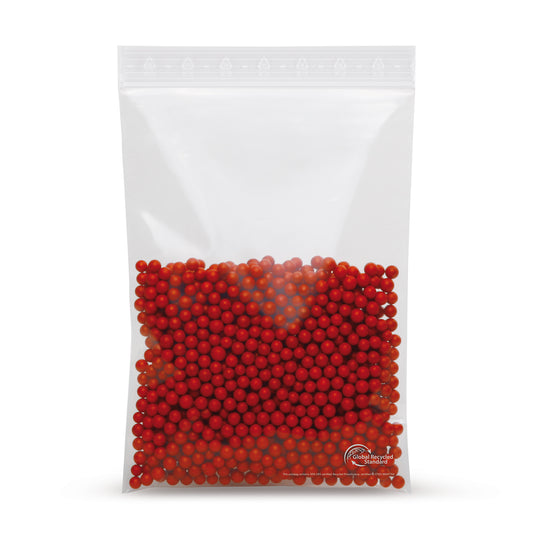
 Regular price From 12,57 €Regular price
More sustainable packaging solutions
More ziplock bag variants
- Ziplock bags overview
- Ziplock bags with recycled content
- Transparent ziplock bags
- Food-grade ziplock bags
- Extra strong ziplock bags
- Ziplock bags with write-on panel
Popular individual products from this range:
Shipping & terms
Shipping from our German warehouse. Sustainable standard sizes are mostly in stock; custom printing is arranged on a case-by-case basis within the delivery time window. All customers – B2B and B2C alike – receive volume pricing (no minimum order value). Free samples and GRS/ISCC certificates on request.
What are sustainable ziplock bags?
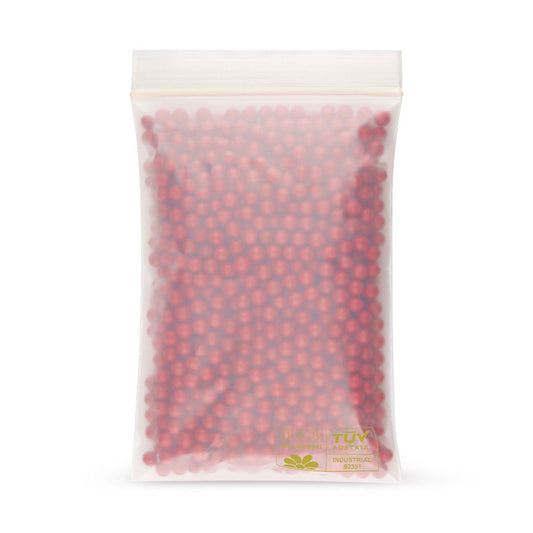
Sustainable ziplock bags are zip bags manufactured with a reduced environmental impact in mind – without sacrificing the proven functionality of the zip closure. They come in three key variants: first, as PCR bags with a high post-consumer recycled content (typically 30 to 80%); second, as bio-PE bags from sugar cane ethanol with a positive CO2 balance; third, as mono-material bags (mono-LDPE) that can be returned to the recycling stream via kerbside collection after use.
The advantage of ziplock bags lies in their reusability – at their core they are already more sustainable than single-use films, because a single bag is often used several times over weeks or months. Anyone who combines this reuse with recycled or bio-based material achieves a markedly improved environmental footprint. Especially in markets sensitive to greenwashing – organic food, natural cosmetics, sustainable fashion brands – choosing the right bag variant is a visible brand signal.
Our sustainable ziplock bags are food-grade in accordance with EU 10/2011 (with food-grade PCR or bio-PE), printable with mineral-oil-free printing inks and available from stock in common standard formats. On request, we supply GRS, ISCC or DIN EN certificates to document your sustainability claims. This lets you advertise in a legally compliant and verifiable way, without having to fear accusations of greenwashing.
What are sustainable ziplock bags suitable for?
- Organic and natural food brands: packaging must match the organic ambition, without greenwashing
- Natural cosmetics refill concepts: resealability for refillable care sets
- Artisan food producers: small runs with high brand value and sustainable packaging
- Eco-labels & direct marketing: online shops with an explicit sustainability promise
- Professional kitchens with ESG reporting: catering and hospitality with a sustainability audit
- Consumer refill stations: zero-waste shops with reusable packaging options
Which sustainability variant is the right one?
- PCR LDPE 30%: entry-level sustainability, cost-efficient, GRS-certified
- PCR LDPE 80%: premium recycled content, visible marketing advantage
- Bio-PE from sugar cane: favourable on the CO2 balance, bio-based with ISCC Plus
- Mono-LDPE (mono-material): fully recyclable via kerbside collection
- Combination of bio-PE + mono-material: the most sustainable variant, with both
- Food-grade compliance: food-grade PCR or bio-PE in EU 10/2011 quality
- Printing: mineral-oil-free printing inks for full recycling compatibility
- Certifications: GRS, ISCC, Recyclass-certified depending on marketing needs
Your benefits with sustainable ziplock bags from Elke Plastic
We have been importing packaging bags since 1976 and have been watching the market for sustainable films since the first pilot projects of the 1990s. For you, that means honest advice instead of marketing platitudes. We tell you clearly which variant delivers genuine added value, which certificates are robust and which claims you may communicate in a legally compliant way – without the risk of a cease-and-desist over vague "eco" promises.
Sustainable ziplock bags place particular demands on closure quality: PCR recyclates behave differently during heat sealing than virgin material, and bio-PE has a slightly different melting characteristic. Our suppliers work exclusively with tested formulations, so that the closure function is maintained even after several hundred opening and closing cycles. This matters, because a sustainable bag with a questionable closure misses its purpose.
Shipping is from our German warehouse. Sustainable standard sizes are usually in stock; custom printing is scheduled accordingly. All customers – B2B and B2C alike – receive volume pricing. Free samples for material testing are a matter of course – test the closure quality, film feel and printability in advance before you approve the range.
Frequently asked questions about sustainable ziplock bags
What makes a ziplock bag sustainable?
Three key properties: (1) recycled material (PCR recyclate) in the construction, (2) bio-based raw materials such as bio-PE from sugar cane, (3) a mono-material construction for full recyclability. Ideally, a variant combines several of these properties.
What distinguishes PCR recyclate from bio-PE?
PCR recyclate is reprocessed waste plastic from consumer recycling. Bio-PE is obtained from sugar cane ethanol and is chemically identical to conventional PE. PCR reduces the need for virgin material; bio-PE reduces the need for fossil raw materials. Both have a place in the sustainable range.
Does the zip closure also work reliably on PCR bags?
Yes, provided high-quality formulations are used. PCR material behaves slightly differently during heat sealing than virgin material – our suppliers have adapted this in production. In practical use, no difference from standard stock is noticeable.
Are sustainable ziplock bags food-grade?
Yes, provided food-grade material is used. PCR recyclate for food contact must meet stricter requirements than industrial PCR – we supply declarations of conformity on request. Bio-PE is fully food-grade, as it is chemically identical to standard PE.
How much CO2 do I actually save?
The CO2 saving depends on the variant chosen. PCR recyclate typically cuts 30–50% of the greenhouse gases per bag. Bio-PE can even be carbon-negative on balance, since plant growth captures CO2. We pass on specific cradle-to-gate data from our suppliers on request.
Are the bags identifiable in kerbside collection?
Mono-material LDPE bags are recognised in common sorting plants and recycled in the PE stream. For maximum sortability, we recommend printing the resin code (PE-LD). Classic composite ziplock bags, by contrast, are difficult to recycle.
What does GRS certification mean?
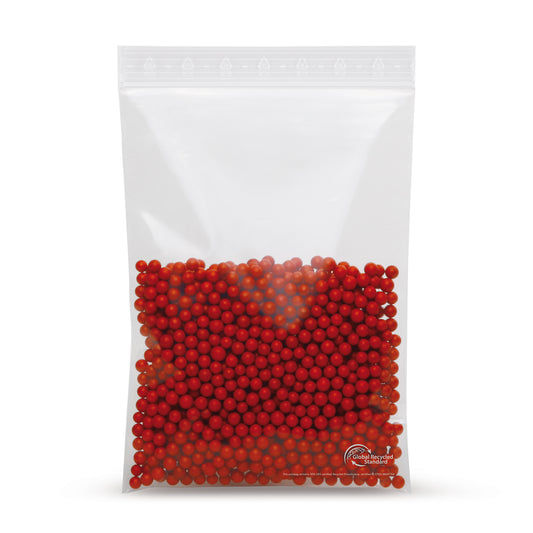
GRS (Global Recycled Standard) is an internationally recognised certificate that seamlessly verifies the recycled content from the collection point to the finished product. For advertising with recycled content, GRS is the most robust proof and is required by many ESG audits.
What claims am I allowed to communicate on the packaging?
Verifiable facts such as "made from X% recycled material" or "bio-based from sugar cane" are unproblematic as long as certificates are held. Avoid vague terms such as "environmentally friendly" or "green" – they are not robust and can be deemed misleading.
Which printing is ideal for recyclability?
Mineral-oil-free and water-based printing inks preserve recyclability. Classic solvent-based gravure inks can disrupt the recycling stream. For maximum recycling-friendly printing, we recommend partly printed variants with a window layout.
What order quantities make sense?
Stock items in standard sizes are already available from stock. Custom printing becomes worthwhile from larger quantities – then the surcharge for sustainable films also pays off. We advise on order quantity calculations.
Why do sustainable bags cost more?
The surcharge results from several factors: a more involved recycling process for food-grade PCR, higher raw material prices for bio-PE, lower economies of scale for specialised films. A surcharge of 10–30% over standard stock is typical. For brands with a sustainability positioning, this quickly pays off through end-consumer acceptance.