
-
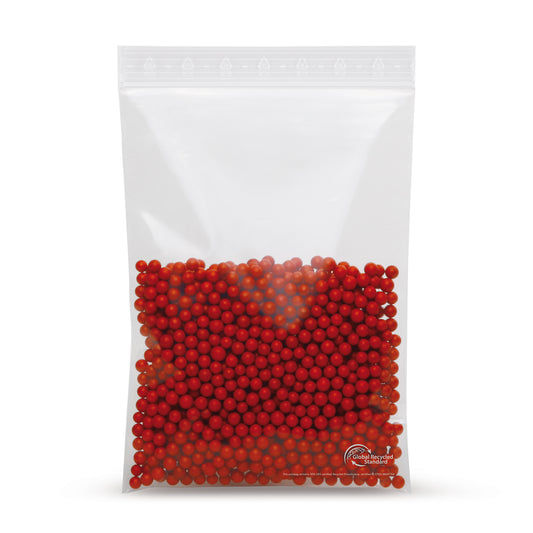
 Regular price From 5,70 €Regular price
 -
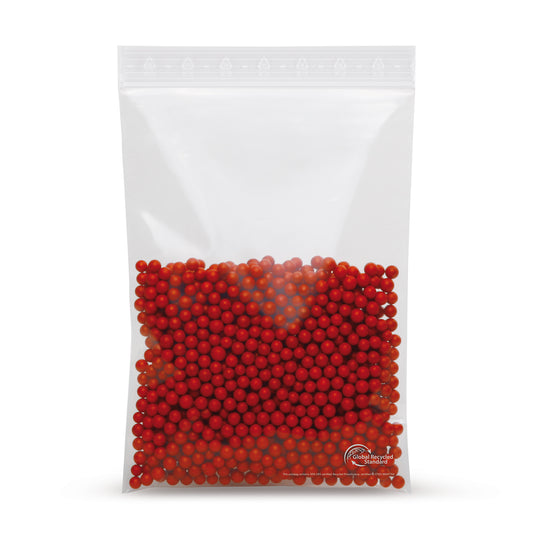
 Regular price From 12,57 €Regular price
More ziplock bag variants
- Ziplock bags overview
- Sustainable ziplock bags
- Transparent ziplock bags
- Food-grade ziplock bags
- Extra strong ziplock bags
- Ziplock bags with write-on panel
Popular individual products from this range:
Shipping & terms
Shipping from our German warehouse. PCR standard sizes are usually in stock; individual recycling ratios and printing are arranged on a case-by-case basis within the delivery time window. All customers – B2B and B2C alike – receive volume pricing (no minimum order value). GRS certificates and free samples via our enquiry form.
What are ziplock bags with recycled content?
Ziplock bags with recycled content contain post-consumer recyclate (PCR) – that is, LDPE granulate from the household recycling stream – which, after industrial reprocessing, is turned back into film. The decisive difference from classic recyclate films made from industrial recycling: PCR comes from the consumer loop (kerbside collection, DSD), and therefore closes the loop where most packaging actually arises – at the end consumer.
The recycled content is precisely defined and seamlessly verified by the GRS certificate (Global Recycled Standard). Typical ratios in our range are 30, 50 and 80% PCR content. The higher the content, the more visible the recycling aspect – although the film loses a little of its see-through appearance as the recyclate ratio rises, since recyclate can look slightly yellow-grey and flecked. For marketing purposes this is often even desirable, because it underlines the authenticity of the recycling.
Our ziplock bags with recycled content are available as a food-grade variant (with additional PCR purity testing for food contact) or an industrial variant (for non-food applications). The closure function remains identical to standard stock – our suppliers have adapted the sealing parameters for PCR films, so that even at 80% recyclate content the bags still close reliably. Printing is possible with mineral-oil-free printing inks, in order to preserve recyclability after use.
What are PCR ziplock bags suitable for?
- Brands with recycling marketing: "X% from recyclate" as a verifiable advertising claim
- Companies subject to ESG reporting: GRS certificates as audit evidence
- Organic and natural food brands: food-grade PCR for food contact
- Industrial ranges: screws, workshop supplies with a sustainability ambition
- Direct-to-consumer marketing: a visible sustainability signal in the shipping packaging
- Public procurement: municipalities and authorities with recycling requirements
Which PCR ratio is the right one?
- 30% PCR: entry-level recycling ratio, cost-efficient, clearly visible marketing effect
- 50% PCR: balanced middle ground between recycling level and film appearance
- 80% PCR: maximum recycling ratio, visibly sustainable brand positioning
- Food-grade variant: PCR specially approved for food contact (EU 10/2011)
- Industrial variant: PCR for non-food applications, cost-optimised
- GRS-certified: Global Recycled Standard with seamless supply chain documentation
- Film thickness: 50, 70 and 90 microns available depending on load requirements
- With or without write-on panel: depending on your storage and marketing concept
Your benefits with PCR ziplock bags from Elke Plastic
We have been importing packaging bags since 1976 and have followed the market for PCR films from the very start. For you, that means verifiable recycling ratios instead of marketing platitudes. On request, we supply GRS certificates, supply chain documentation and detailed material data sheets. This allows you to substantiate your recycling claims in any ESG audit or supplier check – without the risk of a cease-and-desist over vague "recycled" promises.
PCR films place particular demands on heat sealing. Recyclate behaves slightly differently when melting than virgin material – the sealing temperatures have to be adjusted slightly. Our suppliers have adapted this in production, so that the closure function and tightness are identical to standard stock. If you have your own filling processes, we advise you on the correct sealing parameter settings.
Shipping is from our German warehouse. PCR standard sizes are usually in stock; individual ratios or printing are arranged on a case-by-case basis within the delivery time window. All customers – B2B and B2C alike – receive volume pricing directly in the order table (no minimum order value), and GRS certificates on request. Free samples are a matter of course – test the appearance and closure quality in advance.
Frequently asked questions about ziplock bags with recycled content
What is PCR recyclate?
PCR stands for post-consumer recyclate: plastic recovered from the consumer waste stream (kerbside collection, DSD), reprocessed and turned back into film. Unlike industrial recyclate, PCR closes the loop where most packaging actually arises – at the end consumer. For marketing claims, PCR carries more weight than industrial recyclate.
What does GRS certification mean?
GRS stands for Global Recycled Standard, the leading international certificate for recycled content. It provides seamless proof of where the recycled raw material comes from, how it was processed and what proportion is contained in the finished product. For ESG audits, GRS is usually a mandatory form of evidence.
Which PCR ratio should I choose?
For marketing visibility, 30% is often enough – it is clearly communicable without the film losing its see-through appearance. For maximum recycling impact, 80% is the highest available on the market. 50% is a good middle ground that balances recycling effect against film clarity.
Are PCR bags food-grade?
Not every PCR film is automatically approved for food contact. Food-grade PCR with additional purity testing must be used. We stock food-grade variants in 30% PCR – higher ratios are technically more demanding and more expensive.
Does the recycled content impair the closure function?
No, provided high-quality formulations are used. Our suppliers have adapted the sealing parameters for PCR films so that the zip closure function and tightness are identical to standard stock. The closure quality is maintained even after several hundred opening and closing cycles.
What does a PCR film look like?
30% PCR film looks almost like standard clear stock, with a minimal tint. 50% PCR shows a slight grey tint. 80% PCR films have a visible yellow-grey discolouration and are sometimes flecked with small coloured specks (residues of the original colours). Many brands use this deliberately as an authentic recycling signal.
Can I print PCR bags with a logo?
Yes, custom printing is available. For recyclability, we recommend mineral-oil-free printing inks. GRS logos may be printed on, provided a certificate is held. Against a coloured PCR background, light printing inks work best.
What am I allowed to communicate on the packaging?
Clearly substantiated facts: "made from X% recycled material (PCR)", "GRS-certified", "from kerbside collection". Avoid vague wording such as "recycled" without a ratio, "eco" or "green" – these are legally risky and little valued by the end consumer.
How does PCR differ from sustainable bags?
PCR is one specific sustainability strategy (recycled material). Under "sustainable" we group all environmentally friendly variants: PCR, bio-PE and mono-material. If you want to communicate a recycling ratio specifically, choose PCR. If you are looking for the broader sustainability narrative, also look at bio-PE and mono-material.
Are PCR bags recyclable via kerbside collection?
Yes. Like conventional LDPE, PCR LDPE is recyclable in the PE stream via kerbside collection. For full circularity, we recommend printing the resin code (PE-LD).
What order quantities make sense?
Stock items in standard sizes with a 30% PCR ratio are available from stock. Higher ratios or custom printing become worthwhile from larger quantities. We advise on order quantity calculations and volume pricing.