
-
 Regular price From 60,45 €Regular price
 -
 Regular price From 40,94 €Regular price
 -
 Regular price From 49,91 €Regular price
 -
 Regular price From 49,50 €Regular price
 -
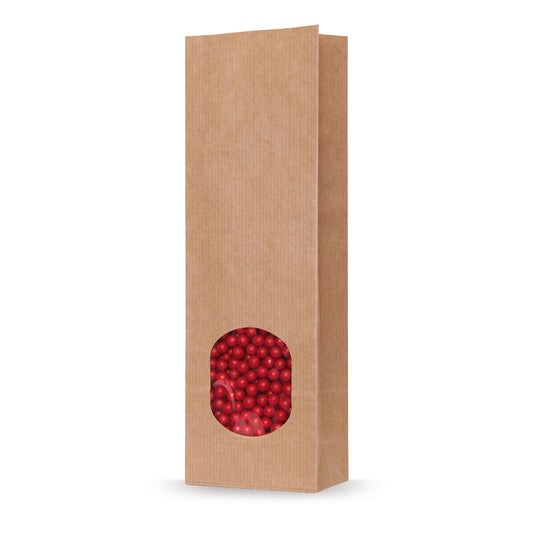
 Regular price From 53,81 €Regular price
 -
Regular price From 38,34 €Regular price
Further industrial and bulk packaging
Further block bottom bag variants
- Block bottom bags overview
- Block bottom bags 4-ply
- Block bottom bags in natron kraft paper
- Block bottom bags in kraft paper
- Block bottom bags for food
- Block bottom bags with window
Popular individual products from this range:
Shipping & terms
Shipping from a German warehouse. Bulk goods standard sizes are generally in stock; custom sizes and printing are arranged individually within the delivery window. All customers – B2B and B2C alike – receive tiered prices for pallet quantities. Free samples via our enquiry form.
What are block bottom bags for bulk goods?
Block bottom bags for bulk goods are industrial sacks designed for packaging free-flowing materials – powders, granulates, pellets, sand, plant substrates, fertilisers and much more. They differ from standard consumer packaging through a higher number of plies (typically 3- to 4-ply), a stronger base construction and optimisation for machine filling. Bulk goods are typically not packed by hand but via automated filling stations – with volume flows of hundreds of sacks per hour.
The block bottom is particularly well suited to bulk goods applications because it distributes load over a large area and stands stable when filled. For powders and fine granulates, valve sacks are typically used: a small filling opening at the base with a non-return flap lets the displaced air escape in a controlled way during machine filling, then closes by itself. For coarser granulates or pellets, cross seam sacks are suitable, which are sewn with thread or glued after filling.
Our range of bulk goods block bottom bags covers standard sizes from 5 kg (consumer or hobby gardening use) to 25 kg (industrial standard). Various inner coatings are available: PE inner for moisture protection, pure kraft paper for breathability, or PE outer coating for weatherproofing during outdoor storage. For food bulk goods, food-grade variants are available; for industrial chemicals there are special chemical-resistant materials.
What are bulk goods block bottom bags suitable for?
- Food bulk goods: flour, sugar, salt, baking mixes, dried pulses
- Animal feed granulates: dry feed, pellets, pet snacks in consumer convenience
- Fertilisers & garden substrates: garden minerals, potting soil components, soil improvers
- Industrial granulates: plastic granulate, cleaning powders, construction chemicals
- Wood pellets & fuels: heating pellets in 5–10 kg units
- Sand & minerals: construction sand, salt powder, technical fillers
Which bulk goods variant is the right one?
- Fill volume 5–10 kg: consumer and catering standard, hobby gardening
- Fill volume 15–25 kg: industrial standard, bulk animal feed units
- 3-ply: light powders, medium weight
- 4-ply: heavy granulates, harsh storage conditions
- With PE inner: moisture protection for sensitive powders
- Pure kraft paper inner: breathable for flour, seeds
- With valve: machine filling for powder bulk goods
- Cross seam: manual sealing for granulates and pellets
Your advantages with bulk goods bags from Elke Plastic
We have been importing industrial packaging bags directly from the manufacturer since 1976. For bulk goods applications, the sack quality is a direct cost factor: lower tear resistance leads to sack breakage in the warehouse or in shipping, with corresponding complaint and cleaning costs. Our suppliers meet the strict requirements for consistent strength across pallet quantities.
Our packaging specialists advise on the sack configuration for your specific type of bulk goods: for fine flour, the valve sack is the efficient filling technique. For coarse pellets, cross seam sacks are more practical. For moisture-sensitive powders, a PE inner coating is essential. For animal feed with a mould risk, a breathable kraft paper inner ply is preferable.
Shipping takes place from a German warehouse. Standard sizes are generally in stock; custom sizes and printing are scheduled individually. Order any quantity for hobby or garden applications. All customers – B2B and B2C alike – receive tiered prices for pallet quantities. Free samples are of course available on request – test the tear resistance and valve function on your filling line.
Frequently asked questions about bulk goods block bottom bags
What are bulk goods?
Bulk goods are free-flowing materials that flow under gravity – powders, granulates, pellets, sand, grains, grain mixtures. They are typically packaged not piece by piece but volumetrically or gravimetrically. Bulk goods packaging differs from unit goods packaging through its suitability for automated filling lines.
What is a valve sack?
Valve sacks have a small, rectangular opening at one corner of the base with an internal non-return flap. During machine filling, the filling jet pushes the flap open and the air escapes. After filling, the flap closes automatically. For fine powdery bulk goods with a high filling rate, the valve is the most efficient technique.
How does a valve differ from a cross seam?
Valve sack: machine filling, self-closing valve. Cross seam sack: open filling at the sack mouth, manual sealing by sewing or gluing. The valve is more efficient for powders, the cross seam more practical for coarser granulates and pellets.
How much weight can the sacks hold?
3-ply: 10–15 kg. 4-ply: 20–25 kg. For higher loads there are 5- or 6-ply special versions. The base construction (glued, sized, sewn) is also important – it significantly affects the load capacity.
Are the sacks weatherproof?
Pure kraft paper sacks without a PE coating are not waterproof – in driving rain they soften. With a PE inner or outer coating they are splash-proof. For outdoor storage we recommend a PE outer layer or an additional film outer wrap.
Which sack variant for moisture-sensitive powders?
For white flour, baking powder, some garden minerals and cleaning powders: a PE inner coating is mandatory. For bulk moisture (e.g. dry flour with a mould risk), however, the breathable variant may be better. Advice on a case-by-case basis.
Can the sacks be stacked?
Yes, the block bottom is optimised for pallet stacking. A standard pallet height typically comprises 6–10 layers. For higher stacks, even load distribution must be ensured – oversized sacks can hang over the edge at the top and compromise stability.
Are the sacks food-grade?
For food bulk goods, food-grade variants are available with a declaration of conformity to EU 10/2011. For industrial applications (fertilisers, chemicals, construction materials), technical variants are approved.
How many sacks per pallet?
For 25 kg sacks, typically 40 units per Euro pallet (1000 kg). For 10 kg sacks, 80–100 units. The loading concept depends on the sack size and the pallet's load capacity.
Can the sacks be printed?
Yes, letterpress or flexographic printing. For industrial bulk goods, 1–2-colour designs with clear product details are usually common. For consumer animal feed or premium garden brands, more elaborate multi-colour prints are common.
Are smaller runs possible?
Stock items in standard sizes are available from stock. Custom printing pays off from larger runs onwards – typically from several thousand units. For smaller runs, labelling with adhesive industrial labels is a flexible alternative.