
-
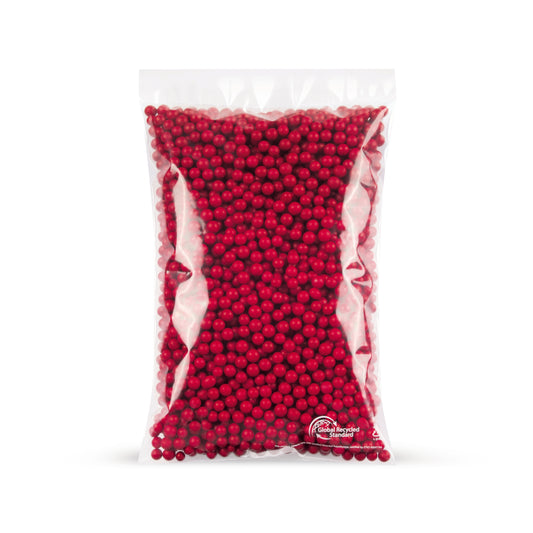
 Regular price From 2,86 €Regular price
Further flat bag variants
- Flat bags overview
- Sustainable flat bags
- Transparent flat bags
- Food-grade flat bags
- Extra strong flat bags
- Flat bags for shipping
Popular individual products from this range:
Shipping & terms
Shipping from our German warehouse. Standard PCR sizes are generally in stock; individual recycled-content percentages and printing are scheduled individually within the delivery window. All customers – B2B and B2C alike – receive tiered pricing (no minimum order value). GRS certificates and free samples via our enquiry form.
What are flat bags with recycled content?
Flat bags with recycled content contain post-consumer recyclate (PCR) – LDPE granulate from the household recycling stream – which, after industrial reprocessing, is turned back into film. Unlike classic industrial recyclate, PCR closes the loop where most packaging is created: at the end customer. For marketing claims and ESG audits, PCR is more meaningful than industrial recyclate because it represents a genuine circular economy.
Flat bags are technically well suited to high PCR contents, as their simple single-layer structure can take up recyclate without compromising functionality. Whereas composite films with high-barrier layers are often limited to 30% PCR, flat bags can be reliably produced even with 80% PCR content. The recycled content is precisely defined and documented seamlessly from collection point to finished product via the GRS certificate (Global Recycled Standard).
Our range of flat bags with recycled content is available as a food-grade variant (with additional PCR purity testing for food contact) or an industrial variant (for non-food applications). Depending on the percentage, the film is slightly more tinted than pure virgin material – many brands even use this effect deliberately as an authentic recycling signal. On request we supply GRS certificates, cradle-to-gate data and declarations of compliance to document your sustainability claims.
What are PCR flat bags suitable for?
- Brands with recycling marketing: “X% from recyclate” as a verifiable advertising claim
- Companies subject to ESG reporting: GRS certificates as audit evidence
- Organic and natural-food brands: food-grade PCR for food contact
- Public procurement: municipalities and authorities with recycling requirements
- End-customer direct marketing: a visible sustainability signal in shipping
- Industrial B2B with eco ambitions: component packaging with a recycling claim
Which PCR percentage is the right one?
- 30% PCR: entry-level percentage, cost-efficient, with a clearly visible marketing effect
- 50% PCR: a balanced middle ground between recycling rate and film appearance
- 80% PCR: maximum recycling rate, a visibly sustainable brand positioning
- Food-grade variant: PCR specifically approved for food contact (EU 10/2011)
- Industrial variant: PCR for non-food applications
- GRS-certified: Global Recycled Standard with seamless supply-chain evidence
- Film thicknesses 50/70/90 microns: all standard film gauges available
- With or without a Euro hole: hanging presentation or pure packaging use
Your advantages with PCR flat bags from Elke Plastic
We have imported packaging bags since 1976 and have followed the market for PCR films from the very beginning. For you, that means verifiable recycling rates instead of marketing platitudes. On request we supply GRS certificates, supply-chain evidence and detailed material data sheets. This lets you substantiate your recycling claims in any ESG audit – without the risk of legal warnings from unspecific “recycled” promises.
Flat bags are technically particularly well suited to PCR: the simple single-layer structure allows high percentages without loss of functionality. Our suppliers have adapted the sealing and welding parameters for PCR films, so that even 80% PCR films are reliably tear-resistant. For your own filling processes we advise you on the right machine settings for PCR films.
Shipping is from our German warehouse. Standard PCR sizes are generally in stock; individual percentages or printing are scheduled accordingly. All customers – B2B and B2C alike – receive tiered pricing. Free samples and GRS certificates are a matter of course – test the appearance and tear resistance in advance.
Frequently asked questions about flat bags with recycled content
What is PCR recyclate?
PCR stands for post-consumer recyclate: plastic recovered from the consumer cycle (kerbside collection, dual systems), reprocessed and turned back into film. Unlike industrial recyclate, PCR closes the loop where most packaging is created – at the end customer. For marketing claims, PCR carries more weight.
What does GRS certification mean?
GRS (Global Recycled Standard) is an internationally recognised certificate that documents the recycled content seamlessly from the collection point to the finished product. For ESG audits, GRS is usually a mandatory proof for brands advertising recycling.
Which PCR percentage should I choose?
For marketing visibility, 30% is often enough. For maximum recycling effect, 80% is the market maximum. 50% is a good middle ground that balances recycling impact and film appearance.
Are PCR flat bags food-grade?
For food contact, food-grade PCR with additional purity testing must be used. We stock food-grade variants at 30% PCR – higher percentages are more technically demanding.
Does PCR reduce the tear resistance?
No, provided high-quality formulations are used. At 30% PCR there is barely any difference from virgin material. At 80% PCR the tear resistance may be minimally reduced, which is hardly relevant in practice. For premium applications we recommend 30–50% PCR.
What does a PCR film look like?
30% PCR film looks almost like standard clear material with a minimal tint. 50% PCR shows a slight grey tint. 80% PCR films are visibly yellow-grey discoloured and partly interspersed with small coloured specks (remnants of the original colours). Many brands deliberately use this as an authentic recycling signal.
What may I communicate on the packaging?
Clearly substantiated facts: “made from X% recycled material (PCR)”, “GRS-certified”, “from kerbside collection”. Avoid unspecific wording such as “recycled” without a percentage, “eco” or “green” – these are legally sensitive and little valued by end customers.
How does PCR differ from sustainable bags?
PCR is a specific sustainability strategy (recycled material). Under “sustainable” we group all environmentally friendly variants: PCR, bio-PE and mono-material. Those who specifically want to communicate a recycling rate choose PCR.
Are PCR bags recyclable via kerbside collection?
Yes. PCR-LDPE, like conventional LDPE, is recyclable in the PE stream via kerbside collection – a double circular effect. For full circularity we recommend printing the resin code (PE-LD).
Which printing is ideal for recyclability?
Mineral-oil-free and water-based printing inks preserve recyclability. Classic solvent-based gravure inks can disrupt the recycling stream. For the most recycling-friendly printing we recommend partially printed variants.
What order quantities make sense?
Stock items in standard sizes with 30% PCR are available from stock. Higher percentages or individual printing are worthwhile from larger quantities. We advise on order-quantity calculations.
Why do PCR bags cost more?
The surcharge results from a more complex recycling process, higher raw-material costs and lower economies of scale. Typically a 10–30% surcharge over standard goods. For brands with a sustainability positioning, this quickly pays off through end-customer acceptance.