
-
 Regular price From 30,63 €Regular price
More side gusset bag variants
Shipping & terms
Shipping from our German warehouse. Transparent side gusset standard sizes are usually in stock; custom printing is arranged individually within the delivery time window. All customers – B2B and B2C alike – receive tiered prices (no minimum order value). Free samples via our enquiry form.
What are transparent side gusset bags?
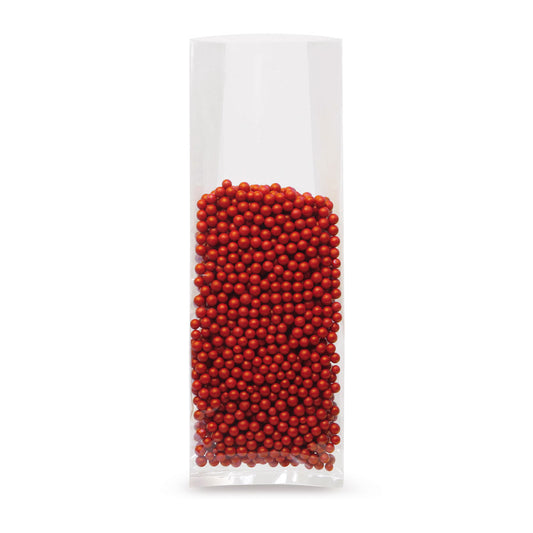
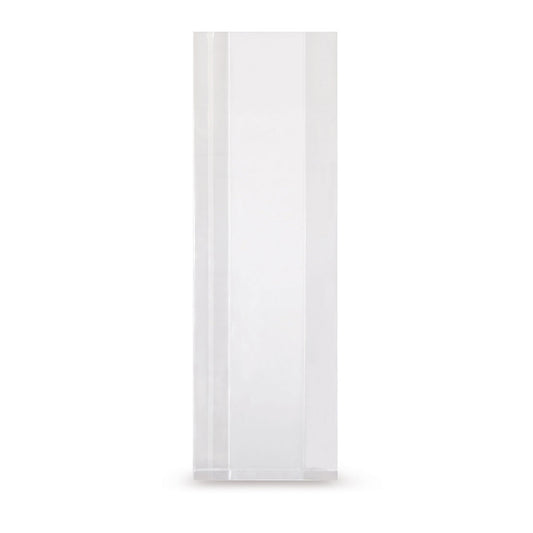
Transparent side gusset bags are the clear version of the classic side gusset design. Unlike plain flat bags, they have lateral gussets that expand as they are filled – creating a box-shaped bag that holds voluminous contents well and stands stably on the shelf. The transparent LDPE film makes the contents immediately visible without having to open the packaging.
Compared with the stand-up pouch, the side gusset design has one important property: it is space-saving in storage (stored flat) and only unfolds into a standing bag once filled. This makes it the cost-efficient standard solution for foods packed in medium to larger quantities – from 500 g to 5 kg. For colourful or visually appealing contents (dried fruit, pasta mixes, confectionery) the transparent version is the strongest selling point: the product sells itself.
Our range of transparent side gusset bags covers typical fill volumes from 250 g to 5 kg. LDPE film in film thicknesses of 50–90 microns, food-grade to EU 10/2011. With or without base reinforcement for heavy contents, with or without a Euro hole for hanging display. PA/PE laminate versions, which offer even higher mechanical strength and vacuum capability, are also available on request.
What are transparent side gusset bags suitable for?
- Pasta & noodle specialities: bright colours are shown off visibly
- Dried fruit & nuts: quality and variety directly recognisable
- Confectionery & sweets: multi-coloured mixes with a clear-view effect
- Flour & baking ingredients: consumer packaging with freshness visibility
- Garden substrates: medium quantities of potting soil, minerals
- Pet food (premium): snacks and treats with a visibility effect
Which transparent side gusset variant is the right one?
- Fill volume 250–500 g: consumer packaging for premium foods
- Fill volume 1–2 kg: standard consumer pack
- Fill volume 2–5 kg: family portions, catering quantities
- Film thickness 50 microns: standard for light contents
- Film thickness 70 microns: more robust applications, heavy foods
- Film thickness 90 microns: extra strong for heavy or sharp-edged contents
- With base reinforcement: load capacity even for volumes of 2 kg+
- With Euro hole: hanging display in retail
Your benefits with transparent side gusset bags from Elke Plastic
We have imported packaging bags directly from the manufacturer since 1976. For transparent side gusset bags the film quality is especially visible: a milky or distorted bag defeats its purpose of clearly showing the contents. Our suppliers meet the strict requirements for clear-view quality even in the larger standard formats.
Our packaging specialists advise on the right film thickness for your application: for light pasta mixes 50 microns is sufficient; for heavy flour packs we recommend 70–90 microns with base reinforcement; for premium foods 90 microns is optimal. For vacuum applications we will direct you to PA/PE versions.
Shipping is from our German warehouse. Transparent side gusset standard sizes are usually in stock; custom printing (semi-transparent with logo strip) is arranged individually within the delivery time window. All customers – B2B and B2C alike – receive tiered prices directly in the order table (no minimum order value). Free samples for advance testing are a matter of course.
Frequently asked questions about transparent side gusset bags
What is the difference between side gusset bags and flat bags?
Flat bags are purely flat bags without gussets. Side gusset bags have lateral gussets that expand when filled – creating a box-shaped bag with significantly more volume for a comparable film area. For voluminous contents, side gussets are more efficient.
What is the difference between side gusset and stand-up pouches?
Stand-up pouches (doypacks) have an integrated K-base for standing presentation. Side gusset bags only become box-shaped after filling, but are not as stable as doypacks. For consumer presentation a doypack is often superior; for industrial B2B packaging side gussets are more efficient.
Are the bags food-grade?
Yes, all standard LDPE side gusset bags are food-grade to EU 10/2011. They are suitable for direct food-contact applications.
What is the standard fill size?
In the consumer segment 500 g–1 kg. For catering 1–2 kg. For family bulk packs 2–5 kg. For industry and bulk goods 5–10 kg.
Are the bags resealable?
Standard side gusset bags have no integrated closure. They are closed with adhesive tape, a heat sealer or a clip band. For resealable applications we recommend stand-up pouches with a zip closure.
Which film thickness is the right one?
50 microns for light contents (pasta, muesli), 70 microns for standard quantities, 90 microns for heavy or sharp-edged contents. For industrial quantities from 5 kg we recommend 90 microns with base reinforcement.
Can the bags be filled by machine?
Yes, side gusset bags are suitable for high-speed packaging machines. For specialised lines, talk to us about machine specifications.
Are sustainable side gusset bags available?
Yes, we have PCR-recycled and mono-material versions in our range. For brands with sustainability positioning these are a visible choice.
How do you prevent creasing during packaging?
Choosing the right size is crucial: the bag should expand its lateral gussets in a controlled way as it is filled. Bags chosen too tight crease at the seam transitions. For premium applications we recommend 10–20% oversize.
Do the bags hold up to DHL shipping?
From 70 microns they are generally suitable for shipping. For sensitive or heavy contents we recommend 90 microns or combination with an outer carton.
Can the bags be printed with a logo?
Yes, partial printing with a logo strip or label area is standard. Printed over the full surface, the transparency loses its effect. For brand cues and mandatory information, partial printing is optimal.